Showing posts with label Isaiah. Show all posts

Friday, October 23, 2015

A Defiled vs Sanctified Heart

This morning I had a wonderful study period with my mom.  We studied Matthew 14-15.  There was a part which stopped us up, and we had a hard time processing what Jesus was saying, so we drew a drawing to help break it down.


Matthew 15 discusses how the scribes PLUS Pharisees came from Jerusalem to Jesus.  (He didn't seek this discussion, they brought it to Him.)  They challenge Him, saying,

"Why do Your taught ones transgress the tradition of the elders?  For they do not wash their hands when they eat bread." (Matt. 15:1)
In various feasts and ordinances the priests are to wash their hands as part of the ordinance.  In Passover feasts, the participants are to "wash their hands" as part of the ceremony.  It is considered cleansing and representative of washing away of sin.

One distinction I like in this translation (The Scriptures) is that the King James use of "disciples" is changed to "Your taught ones".  It brings to mind that the people who followed Jesus were being taught by Him, much like when I enjoy learning from various gurus of our day.  These people followed and studied with Him, learning from Him routinely.  I can think of a few living people I do this with.

So the scribes and Pharisees wanted to know why those who were taught by Him didn't follow the tradition of the elders in washing their hands when they eat bread.  Christ responds,

"Why do you also transgress the command of Elohim because of your tradition?  For Elohim has commanded, saying, 'Respect your father and your mother,' and 'He who curses father or mother, let him be put to death.' 
But you say, 'Whoever says to his father or mother, "Whatever profit you might have received from me has been dedicated," is certainly released from respecting his father or mother.'  So you have nullified the command of Elohim by your tradition.  
Hypocrites!(!!)  Yeshayahu (Isaiah) rightly prophesied about you, saying, 'This people draw near to Me with their mouth, and respect Me with their lips, but their heart is far from Me.  But in vain do they worship Me, teaching as teachings the commands of men.'  
Referring to the drawing again,


on the left side is what Elohim's law declares.  We are to respect father and mother.  If we do not respect them, but curse them, the principle is that death follows.  This was part of the law that was given after Moses had to return to the mount because the Israelites were worshiping other gods.  So this is a basic law of heaven that is being instituted in as simple of form as possible.  Respect your parents; honor them.

Contrast this with what the scribes and Pharisees were teaching, which was "If you kids can pay off your parents (or benefit them through some means), you're released from needing to respect them.  You can pay your way out of the relationship."  (I assume a Hebrew scholar will understand this verse more than I, so this is my layman's interpretation of it.)  If you note the arrows in the drawing, in the Law from Elohim, the love and respect and honor goes from child to parent.  It illustrates gratitude, and promotes harmony from one line of descendants to another.  It imitates the respect, love, and glory Christ shows to his Father.  Gratitude is one thing that ties hearts together, and when a child shows gratitude for the sacrifices of their parents, it allows the parents to be honored and reciprocate love to the child more readily.  It seems to be a natural law of the universe, or a law of heaven, I suppose.  It is a true principle in my life at least.

However on the right side, it encases greed, selfishness, and lack of relationship or respect from child to parent.  It is self-serving.  It is disharmony.  The child has no eternal gratitude but to pay off the parent with some form or money or "profit".  The relationship becomes more temporary, as ties seem to be severed and released.  They are "free".

{As a sidenote, this resembles Satan's efforts in the councils at the beginning of this world.  He wanted to collect the glory, severing his ties with Elohim.  In essence create his own, disconnected kingdom with no reciprocation of gratitude, glory, or respect for Elohim.  "Glory be mine" mentality.  See Moses 4:1-4.}  

This discussion expresses the heart to me of what Jesus is saying.  After the scribes + Pharisees interrupt their lesson, he gathers in the taught ones and explains the whole crux of the matter.
"And calling the crowd near, He said to them, "Hear and understand: "Not that which goes into the mouth defiles a man, but that which comes out of the mouth, this defiles the man."
Then his taught ones came and said to Him, "Do You know that the Pharisees stumbled when they heard this word?"  
But He answering, said, "Every plant which My heavenly Father has not planted shall be uprooted.  Leave them alone.  They are blind leaders of the blind.  And if the blind leads the blind, both shall fall into a ditch."  
And Kepha (Peter) answering, said to Him, "Explain this parable to us."
And Yeshua (Jesus) said, "Are you also still without understanding?  Do you not understand that whatever enters into the mouth goes into the stomach, and is cast out in the sewer?  But what comes out of the mouth comes from the heart, and these defile the man.  For out of the heart come forth wicked reasonings, murders, adulteries, whorings, thefts, false witnesses, slanders.  These defile the man, but to eat with unwashed hands does not defile the man.  And Yeshua went out from there and withdrew to the parts of Tsor and Tsidon."  
How is (y)our heart?  Do the things which come out of it defile us?  Or does it sanctify us?

So thankful for this powerful lesson.

Love You Jesus.  Love you, reader.   

Friday, April 20, 2012

All is Well

For the last week or so I've been working on a book called Nephi's Isaiah, by Denver Snuffer.  I hope no one gets tired of hearing me source his writings.  I've found them to be quite impressionable in my mind, and have been quite prayerful in determining if I believe some of his interpretations of scripture.  Much of what he writes I feel very enlightened by.


One thing I read today really has me pondering. 

He writes about "Zion".  Latter-day Saints have scripture that defines Zion as the "pure in heart".  The author describes how we are nowhere close to achieving Zion, and we have much to repent of.  Much too much greed, selfishness, hard-heartedness, pride, etc.  This I can agree with.

He then discusses how there are no poor in Zion, and that we have not yet taken care of our poor.  He also quotes Nephi in saying that there are those that remain in their poor states because they lack learning.  I tried to believe this one, but thus far, I have a hard time understanding if this is to be taken on a local (Utah), national (US), or international scale. 

I could consider myself and our family poor.  We live in a mobile home in an area that many would call the "ghetto" of our town.  We have more student loan debt than I am happy with, and credit card debt to match the student loans.  Thus far, job prospects in this miserable economy are very, very scarce, and these bills exceed our current standard of living.

That said, I feel very wealthy.  Despite our debt, we have ALL of our needs met.  Gas for the cars (thank you, Mastercard), the most comfortable beds one could imagine (thank you SleepNumber), food in our fridge (thank you coupons), and for living in the "ghetto", I feel safe walking the street at night (Praise God for all!:).  We have electricity to light every room, clean, drinkable running water, and health care available to anyone.  (Granted, I have no health insurance, but that doesn't mean I can't get care if I need it, with multiple hospitals within a 10 minute drive.)  We have access to free libraries where I can read just about any book I want, on any topic I can conceive of.  And if I really needed help, there are a myriad of places I could count on to get help, should I be in desperate circumstances.  I can say, write, and think what I want, without fear of persecution or imprisonment.  I am so blessed, and so is every soul who lives in this land of freedom, even if they truly do live in a real ghetto.

When contemplating my rich and poor estate, I wonder, "Have I lacked because of my poverty?  Has our family not had the opportunity for a good education because of our lack of money?"  I think this is all relative.  I honestly can't grasp what Snuffer is talking about, unless he's talking on the global scale here.  Perhaps it is because I live in relative security, and have never truly been out on the streets.  Is this what he's talking about - that Nephi is warning us to help the homeless and hungry more?  Do we not have places that take care of these matters readily?  Or is he saying that we should be more individually invested in doing this care-taking for those around us? 

When it comes to education, I know there are millions of people who would LOVE to have the so-called "crappy" education people whine about being so abysmal in the US.  Perhaps in Chile or Ghana they don't have access to Visa or Mastercard to cover their school expenses not covered by Government sponsored student loans.  (My friend Jessie told me US student loan debt has now topped $1 trillion.  All for "education".)  

I went to political caucuses here in Utah a few weeks ago, and heard people whining about so many things.  Things they felt entitled to, like a "better" education, ensuring their "social security", and "medicare" and "medicaid".  It disgusted me, that in a room full of 90% Mormons, at least half of the room was more concerned about not losing their benefits than the effect their government dependence would have on the upcoming generation.  I really don't get Snuffer's suggestion here.  Perhaps he thinks that we, as Latter-day Saints, should be sponsoring one another in these endeavors.  Should I expect him, Brother Snuffer, a successful attorney, to aid me in paying off my education?  Is this what he was referring to?  {Maybe he was!  If that's the case, I welcome anyone with a load of money to feel free to contribute to our cost of education. :)}

Despite my lack of understanding, I have felt compelled lately to be more involved, globally.  Our world is so much smaller than it ever has been, in the sense that we can talk to someone around the world on the phone if we like.  Airplanes cross the globe daily, so sending assistance to those truly poor is just a matter of having enough postage to get the help there.  I don't feel like many here in the United States have a clue.  Many US Constitution lovers say the Constitution tells us to mind our own business, globally.  I submit that had the technology existed to assist those in other countries when the Constitution was constructed, the Founding Fathers certainly would not have prohibited us from assisting others because they're beyond our borders.  Is this what Nephi's talking about?  Would he be concerned that we stay within our man-made boundaries?

There was a man holding a sign asking for money here in Orem several months ago.  I got out of my car and offered him some of my groceries in the trunk.  He turned me down.  Was it that he wasn't hungry, but just wanted money?  I shake my head in confusion. 

Back to the start.  Brother Snuffer, since we can't comment on your blog, I'd surely like to know, if LDSs are not doing nearly enough to help those around them, what more do you suggest?  Is it that it isn't sufficient to donate monies to the tithe and offering funds?  Do we need to be more personally involved?  Or am I just completely and utterly spoiled, even in my lower class level of US living?  That's probably the case. 

And as far as education, my opinion is that anyone–at least in the United States–who puts forth enough work and is inquisitive enough has the world of opportunity available to them.  If not in your state, walk to another one.  Hitchhike, whatever.  At least here in America, you have the freedom to do so.  I thank my Father in Heaven for that freedom.  Many beyond our borders are not so fortunate.

Thursday, March 15, 2012

Jesus talks about Isaiah's Prophecies, Part 2

(This is the second half of what is currently a two-part post.  To see the predecessor, see here.) 

In the previous post, I explained a little bit of the set-up to the views I'm about to share.  Jesus had been preaching among the Nephites, following his resurrection.  He had been sharing his "gospel" among them, and as each day progressed, more and more of the people joined the multitude who were trying to hear his words, and see the miracles he preformed.

Many, many wonderful things happened, and I hope to devote a whole series to my thoughts on the details in the near future.  What I'd like to focus on today is where he refers to Isaiah, and how he said all of his prophecies should be fulfilled (3 Nephi 20:11).  He proceeds, "...when they shall be fulfilled then is the fulfilling of the covenant which the Father hath made unto his people, O house of Israel.  And then shall the remnants, which shall be scattered abroad upon the face of the earth, be gathered in from the east and from the west, and from the south and from the north; and they shall be brought to the knowledge of the Lord their God, who hath redeemed them."

I could copy the rest of the chapter, but I'll try to summarize, and share my thoughts.

He explains that if the Gentiles don't repent after they receive their blessing, after they have scattered the remnant of the house of Jacob, then "shall ye, who are a remnant of the house of Jacob, go forth among them; and ye shall be in the midst of them who shall be many; and ye shall be among them as a lion among the beasts of the forest, and as a young lion among the flocks of sheep, who, if he goeth through both treadeth down and teareth in pieces, and none can deliver." (3 Nephi 20:15-16)

A few questions and simple answers now...

Who are the Gentiles? Anyone not a Jew, correct?  Earlier in the Book of Mormon the "scattering" of the remnant of the house of Jacob is prophesied, in 1 Nephi 13.  It refers to a man, brought across the waters by the hand of God, which allows religious freedom to be enjoyed by those who followed him across the waters.  (Many call his man Cristobal Colón:  Christopher Columbus.)

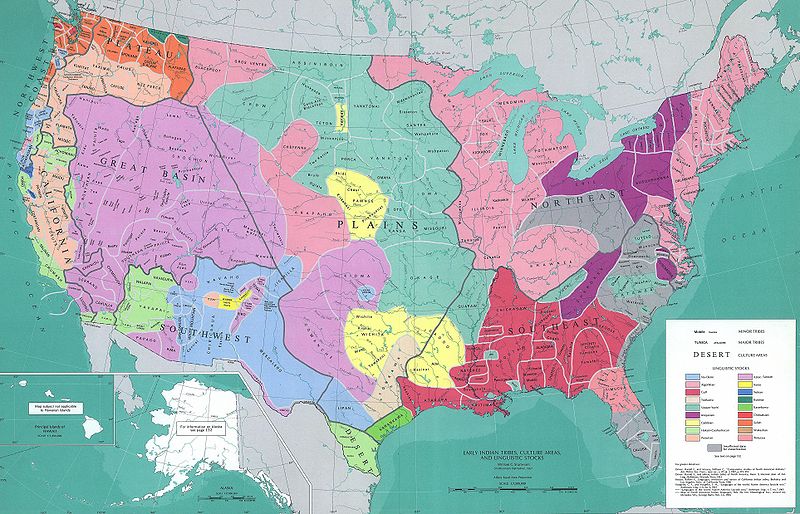
Who are the "remnant of the house of Jacob"?  We understand part of this remnant to be the descendants of Lehi's children, who are believed to have resided in the Americas.  They are to be "scattered", as referred to in 1 Nephi 13:14, by those Gentiles who came across the waters.  Did this not happen to the American Indians?  And where did those who were "scattered" go?  West?  South?  North?

(Map of "Early Localization of American Indians". Photo source, Wikipedia.)
The night before I read 3 Nephi 20, I came across a website where someone quoted the verse about the lion among the beasts of the forest.  They suggested that this referred to the current issue of "illegal immigration" that the US battles.  They also referred to an earlier verse in the Book of Mormon, where it says that anyone lead to this "land of promise" shall have been led by the hand of God, to be a free people.

Another question.  Are people in Canada generally free?  How about Mexico?  Nicaragua?  How about Brazil?  Are people fleeing on handmade rafts to the peaceful coasts of Venezuela?  Ecuador?  Or is it pompous of me to say that America's exceptional state as a "land of promise" is truly that–exceptionally blessed?  Was there some other "Gentile" that went and scattered the people of Central America or Canada?

{This brings in another undeniable point in my mind.  At some point, the descendants of Lehi–this "remnant"–lived in a place where they would be "scattered from".  Were the Mayans or Incas, whom many claim descended from Lehi, ever scattered and driven?  Perhaps I'm illustrating ignorance here.  I don't know for sure.} 

"If the Gentiles do not repent..." what does that mean?  What do the people of America have to repent for?  Which commandments do we break, all the time?  Are not the simplest of commandments Jesus gave us–to love one another–broken by anyone, just about every day?  Which of us is perfect in this regard?  Are any of us perfect, period?  Certainly not me! This does not even touch some of the greater sins of our day, which are becoming more and more acceptable, and more and more commonplace.

So back to the main verse:
"shall ye, who are a remnant of the house of Jacob, go forth among them; and ye shall be in the midst of them who shall be many; and ye shall be among them as a lion among the beasts of the forest, and as a young lion among the flocks of sheep, who, if he goeth through both treadeth down and teareth in pieces, and none can deliver."
Down to the main point.  It seems highly likely to me that the remnant, who is as the lion, are very likely those who the media calls "illegal immigrants".  Descendants of American (or Mexican) Indians, perhaps, re-inheriting this land, whether or not Americans like it.  If we look at the effects of illegal immigration on stolen identities, medicaid fraud, and free education in expensive universities, I would venture to say that they are both treading down and tearing in pieces.  To even consider the affects of Arizona's attempt to have checks on "papers" for illegals has wreaked political havoc.  If enough states took on this issue, there would be even great potential for the "United" states to be "torn to pieces", if not literally, then mentally.  Indeed, this could very well be an accurate unfolding of this prophecy.  

Having working with illegal immigrants as a missionary, I've developed an "I don't know" attitude on how to deal with the issue.  I saw people I taught and came to love dearly get deported, and then be back in Utah within barely a week.  It seemed a waste of money for the government, as well as those deported.  Each of those who I knew who got deported came back, at any/all costs.  

(photo source)
I've prayed about it on more than one occasion as to which view to support (widening the doors on immigrant quota, amnesty, fence building, e-verify, etc.), and regardless, it seems clear to me that it's all in God's hands, no matter which view I take.  Unless the Gentiles repent and turn to God, they will be as sheep with a young lion among them, period.  This prophecy makes complete sense, whether or not this is the literal fulfillment of it.  And the irony of it, is that this illegal immigration issue has only been a serious issue within the last 30 years.  How long ago did we take simple prayer, or even displaying a list of the 10 commandments out of schools or any government buildings?  And Roe vs. Wade?  All sorts of other social turn-arounds from historically accepted norms and values have taken place, and just in my lifetime.  Even to see how some media outlets seem to have completely forgotten the Holocaust, and Jew-hating seems to somehow be justified in the minds of not some, but so many.  It almost feels like I'm living in some pseudo-reality when I hear of these upside-down prejudices coming back to life. 

How thankful it makes me for the blessing of this book of scripture in my life.  It gives peace and comfort in an otherwise unsettling social and political environment.  I know we're in His hands!  And I hope more and more people come to understand these prophecies, especially as they come to be fulfilled. 

Monday, March 12, 2012

Jesus talks about Isaiah's Prophecies, Part 1

Last week I read something that really startled me.  I've been wanting to share it, but haven't really had the words.  I'm not even sure how clearly I can share it now, but I'm going to try.  It was a prophecy contained in 3 Nephi 20.

Jesus came and visited the Nephites who had been in Bountiful, at the temple site.  He spent the whole day with them, working and showing marvelous miracles among the people.  He also chose 12 to stand as "disciples", to minister and run the affairs of the congregations after he would leave.

They went home that night, after Jesus had ascended, and they gathered together the next day, with an even greater crowd, some people having traveled all night to get there.  More and more wonderful things occur, such that I can't even imagine how Mormon, the compiler of the Book of Mormon, even figured out what to include in this account.  There is just so much!

{After studying these verses for several days, I've lost track of whether or not the part I want to discuss here is during the 2nd or 3rd day of Jesus' visit.  It's amazing how much he packed into just a short span of days.  I'll likely come back to 3 Nephi when I finish my 6 month challenge.} 

He starts talking about Isaiah's prophecies, and how they are so important that we need to search them out.  In 3 Nephi 15:6, he says,
"Behold, I do not destroy the prophets, for as many as have not been fulfilled in me, verily I say unto you, shall all be fulfilled."
This was a very interesting point.  Why doesn't he destroy the prophets' words?  In Sunday School, it was recently discussed how Jesus "fulfilled" the law of Moses.  I was confused, because some folks were saying that even though the law was fulfilled, some, like Peter, apparently were still abstaining from eating particular forms of meat.  I was really confused by the whole thing, as I'm not by any means a scholar of the law of Moses.  I'd barely call myself a student.

However, when Jesus says he doesn't destroy the prophets, I was surprised.  I think I must have affiliated the concept of "fulfilling the law of Moses" with "fulfilling the prophets" together.  This is not the case.  Isaiah's prophecies, among other prophecies left to us in the scriptures, are still yet to be fulfilled.

Friday, December 2, 2011

2 Nephi 25, Take 1

My Bishopric gave our ward (congregation) a challenge a few weeks ago, which was to read The Book of Mormon in 6 months or less.  I'm giving it a go.  

Currently, I'm on p. 98, which is 2 Nephi 25.  In the previous chapters, Nephi had recounted the prophecies of Isaiah, and in chapter 25, he decided to explain a little why he did that.  He says that his people, who have now been out of Jerusalem for nearly 40 years, don't know much of the Jews.  He chose not to teach them such things, because of the Jews' wickedness at the time.  He says that the people of the "last days" (vs. 8) will understand these prophecies, and will "know of a surety, at the times when they shall come to pass" (vs.7).  I find this fascinating.

I still read the prophecies of Isaiah, and have no idea what they're talking about, except a few select verses.  So many references to names and places are intimidating, but Nephi says in vs. 5, "I know that the Jews do understand the things of the prophets, and there is none other people that understand the things which were spoken unto the Jews like unto them, save it be that they are taught after the manner of the things of the Jews."  Wow.  So it looks like I need to find a faithful Jewish follower to more greatly understand these prophecies.

Any faithful Jews out there who want to help me understand Isaiah?

~Jen:)
xoxo