Showing posts with label Nephi. Show all posts

Wednesday, May 3, 2017

Nephi's last words

Nephi leaves an ominous warning to the reader of his book.

And now my beloved brethren 
all those who are of the house of Israel 
and all you ends of the earth 

I speak unto you as the voice of one crying from the dust 
farewell 
until that great day will come 

and you that will not partake of the goodness of God 
and respect the words of the Jews 
and also my words 
and the words which will proceed forth out of the mouth of the Lamb of God 
behold I bid you an everlasting farewell 
for these words will condemn you at the last day 
for what I seal on earth will be brought against you at the judgment bar 
for thus has the Lord commanded me and I must obey 
Amen


Having completed a recent reading of 1 and 2 Nephi over the last few months, I ask myself, "What is Nephi's message?"  

Here he warns, that if: 
  • you who choose not to partake of God's goodness, 
  • nor respect the words of the Jews (not necessarily their traditions, which Nephi denounces, but the testaments which come from them), 
  • nor respect Nephi's own words, 
  • nor have ear for the words which come from the Lamb
– these words will condemn those who choose to ignore them.  What is Nephi's overreaching message?  He's pretty serious about wrapping up the book.  He clearly took a lot of effort to share certain things for us.  

My observations: 
  • Nephi's books are filled with visions, revelations, dreams
  • His books recount the consequences of sin
  • He laments openly about his weaknesses
  • He is passionate about loving his God, who he calls "my Jesus" (reminds me of this guy!)
  • He has sealing power
  • He encouraged face to face meeting with God
  • He glories in plainness – there are not "hidden" gotchas that one must try feverishly to read between lines.  
  • He reveals everything he possibly can about how to enter the "path", states little or nothing of special churches, groups, clubs or groups which require pacts, promises, or combinations
  • He preaches the importance of baptism of water, of fire, of Holy Ghost, and entering into the "path"
I have grown to have an immense appreciation and love for Nephi.  I have read and heard others say that they find his writings and personality dry, boring, and humorless.  One author I read commented that he would probably not be likely to participate in friendship with Nephi because he seemed to be a bland kind of guy.  People used to comment in church how they could never "get through" his book, especially his retelling of Isaiah's accounts.  I find that reading Nephi's account in the Simple Copy has opened my eyes up to his heart, his passion, and his personality.  I don't find him dry at all.  I find Olde English dry.  

Friday, January 27, 2017

Words of Moses/Nephi

This afternoon I finished reading and revising 1 Nephi 7 (in my Sloppy Coppy [edit] Simple Copy) for my kids.  Something interesting stuck out to me, probably with current events going on.  This part here:

"But it is the kingdom of the devil which will be built up among the children of men which kingdom is established among them which are in the flesh for the time speedily will come that all churches which are built up to get gain and all those who are built up to get power over the flesh and those who are built up to become popular in the eyes of the world and those who seek the lusts of the flesh and the things of the world and to do all manner of iniquity yes in fine all those who belong to the kingdom of the devil are they who need fear and tremble and quake they are those who must be brought low in the dust they are those who must be consumed as stubble and this is according to the words of the prophet"
(Forgive the lack of punctuation, but that is one purpose of my sloppy copy revision.  It allows me to see the words freshly.)

To bullet this out for clarity, these are identifiers of the enemy's kingdom:

  • established among those in the flesh
  • any/all church built up to get gain
  • all those (churches? individuals?) who are built up to get power over flesh
  • all those (churches? individuals?) who are built up to become popular in the eyes of the world
  • those who seek the lusts of the flesh
  • those who seek the things of the world
  • those who do all manner of iniquity
Bullets 2 and 3 are assumed to speak of churches, but it is possible they refer to individuals as well.  So the question remains, for me, do I participate or encourage any of these things.  Do I worry myself with being in a church built up to get gain, or make money in any way off of people?  Do I seek to get power over flesh?  Do I seek to become popular in the eyes of others, especially the "world"?  Do I seek the lust of my flesh?  Do I seek the things of the world, like fine cars, fine homes, superior schooling, lavish entertainment or self indulgences?  Do I participate in any manner of iniquity?  

It's difficult to say I don't participate in any of those things.  Best not to point the finger, but rather use the words of Nephi, quoting the prophet Moses, for introspection.  


Tuesday, December 18, 2012

Writing Styles

The last week or so I've been reading through Beloved Enos (of course, another Denver Snuffer book).  He points out the writing styles of different authors in the Book of Mormon.  I never paid much attention.

Having observed the truth in his words, I wanted to point out a few.  While this provides greater testament to the divine power of which Joseph translated this record, more interestingly it points out the great differences between the men who etched into the plates.

(photo source-ish)

First is Nephi.  He recorded at great length about the whole of the gospel of Jesus Christ.  At the end of his record, we see his true character and even personality:

I glory in plainness; I glory in truth; I glory in my Jesus, for he hath redeemed my soul from hell.
I have charity for my people, and great faith in Christ that I shall meet many souls spotless at his judgment-seat.
I have charity for the Jew—I say Jew, because I mean them from whence I came.
I also have charity for the Gentiles. But behold, for none of these can I hope except they shall be reconciled unto Christ, and enter into the narrow gate, and walk in the strait path which leads to life, and continue in the path until the end of the day of probation. (2 Nephi 33: 6-9)

Following this, the rest of the chapter – another five verses – is spent as a sign-off.  He refers to the judgment bar of God, and makes the sealing of his record a very formal affair.  It even appears to me that he is following a form of ceremony, or specific direction which would let his name be cleared, if any should misunderstand or ignore his words.  The last verse reads:

For what I seal on earth, shall be brought against you at the judgment bar; for thus hath the Lord commanded me, and I must obey. Amen. (2 Nephi 33: 15)

If we take a look at the latter end of Jacob, the same pattern is observed, however it's within chapter 6.  Jacob had written what he expected to be the end of his record, as the pattern follows Nephi's.  He signs off:

O be wise; what can I say more?
Finally, I bid you farewell, until I shall meet you before the pleasing bar of God, which bar striketh the wicked with awful dread and fear. Amen. (Jacob 6: 12-13)

Note the reference to the "pleasing bar of God"?  Interesting.  The curious part is that there is another chapter following this sign off, and Snuffer suggests that it is likely dictated to and etched by Enos, Jacob's son.  The writing style continues into the book of Enos.


(photo source-ish)

This morning I sat down to study, and asked in my heart as I often do, "Where should I read?"  The answer came to my mind as "Mosiah 10".  Opening there, I noticed that Zeniff was writing, and read words very applicable to what is going on in my life, my country, my world.  By the end of the chapter, Zeniff is also signing off.

And now I, being old, did confer the kingdom upon one of my sons; therefore, I say no more. And may the Lord bless my people. Amen. (Mosiah 10: 22)

What a difference between Zeniff and Nephi and Jacob!  There is no reference by Zeniff to the judgment or pleasing bar of God.  I would wager a guess that Zeniff may have supposed but likely did not know of the specifics of what Nephi included in his sign off. Did he know his words would be available for us to study?  Either way, he signed off in a very unique manner.  Does it matter?  Maybe and maybe not, but it's interesting for me to see a clear distinction in the personality and writing style of these men.  Would it not be interesting to find out why Nephi and Jacob signed off the way that they did, or if there is more meaning to this than we recognize?

Sunday, November 11, 2012

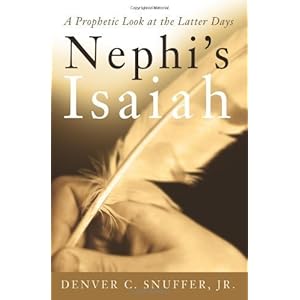
Nephi's Isaiah, by Denver Snuffer Review

I don't know how to even start sharing how thankful I am for this book.


A little over a year ago I began reading Denver Snuffer's works.  I was a bit hesitant to begin The Second Comforter: Conversing with the Lord through the Veil, due to the implications on the cover and the title.  I was hesitant to explore books that weren't "Deseret Book" approved.  A trusted friend recommended it, however, and due to consistent reading of these books, my entire concept of the gospel feels 180 degrees changed, improved, and enlightened.  I am so thankful to God for the books coming out of the keys at Denver Snuffer's computer.  They are truly inspired.  

Nephi's Isaiah is a companion to The Second Comforter, and leads the reader to an enhanced study of the The Book of Mormon.  I always wondered why Nephi took up such great space in The Book of Mormon to cite Isaiah, especially if he knew that we would already have Isaiah's words to read from the Bible.  This book presents a "why", and also a new way to read it.  

There are so many ideas presented in this book that I could likely take a paragraph and blog about it for a week.  If I could quote a few of them, I would, but the book is copyrighted, with no permissions given for quoting, so I avoid doing so... especially since the author is a lawyer. :)  

I have never been very much inclined to read nonfiction gospel study works.  I get bored quickly, and often don't enjoy the simplicity of some of the books, or the odd focuses on the author.  This piece does none of that.  It's not senseless writing, or intended to give the reader excuses on why they can ease up on strict commandments.  It's bold, just like Nephi.  It's clarifying, and makes words and customs easier to understand, and quite frankly, answers so many of the "whys" which I've been looking for answers for for years.  

One point I really enjoyed near the ending is how it is pointed out that Nephi did not have a broad audience to preach to.  He likely felt small, or incidental among his people, even though he was their leader.  He saw our day, but it is clear that he leads more people now than he ever did in mortality.  I find the idea fascinating.  

And as expected from this author, he never takes credit, but acknowledges that anything useful is from God and Nephi, and says that anything useless is his fault.  Always makes me laugh a little.  If we could all be so humble.  


What are your thoughts?  Have you tried any of Snuffer's books?  Would you try one?  Please share if this review has helped you in some way.  Thanks! 

Sunday, September 9, 2012

1 Nephi 1:17 - Nephi's account

1 Nephi 1:17: 

17 But I shall make an account of my proceedings in my days. Behold, I make an aabridgment of the record of my bfather, uponcplates which I have made with mine own hands; wherefore, after I have abridged the record of my dfather then will I make an account of mine own life.
Nephi begins here by expressing that this is his account.  This is his life he's talking about, and it's him doing the recording.  Although this Book of Nephi is held in the Book of Mormon, these are Nephi's words, unabridged at this point.  I feel this is a testament to the law of witnesses.  Perhaps there is some import at the judgment day that Nephi takes the time to make this point clear, and not just to be redundant.  But they are his days.  This is not the account of Laman, Lemuel, Sam, or Nephi's sisters.  He wrote it.  

Nephi also points out he is making an abridgment - or a summary, or more brief record - of his father's experiences.  Why does he do this?  It seems that much of this record already is sharing what happened to his father Lehi.  Is it possible for Nephi to share his story, without first talking about his father, and how he was influenced?  

Once again, he is also setting himself up as a second witness.  His father is one.  Nephi makes two.  In scripture we are told that in the mouth of two or three witnesses shall all things be established (2 Cor. 13:1).  Nephi is fulfilling that law.

It is also awesome to think that somewhere, also likely on metal plates, is Lehi's full, unabridged version of what happened to him.  How cool would it be to have that record revealed, as we know Lehi witnessed a LOT of things that are not contained in this record.  

Also we find out that Nephi made these plates.  Have you ever tried to make metal plates?  would you know how to start?  Would it take a long time?  Where would you find metal to create plates out of?  And why would you use metal?  Nephi surely knew that other means of writing were not going to be able to be preserved.  This tells us (before he tells us) that he knew these records would be shared with a people who would live LONG after he passed from this earth.  

So he found metal.  He had to have dug it from the earth, somehow.  Then he had to melt the metal, and have a means to form it into metal plates.  Can you imagine the process to do this?  Were there college courses for Nephi to learn how to meld metal?  Or how to remove it from the mold?  

And how did Nephi know how to inscribe his language onto metal plates?  Did he learn reformed Egyptian/Hebrew in college?  How long did it take him to form the best tools to do so efficiently?  

As far as words are concerned, do you think that Nephi felt his weakness, knowing that millions of people would eventually find his words at the beginning of a foreign book?  that millions of people would memorize "I Nephi, having been born of goodly parents"?  Did he wonder if his work would be criticized, or judged?  At very least he seemed to recognize the importance of pointing out the need to testify that what he is writing is his, and it is true.

Lastly, Nephi shows a great example of how to write a bit of family history.  First he writes about his father's experience, and shows how it has impacted him.  While this might seem natural to those familiar with writing, those who are just beginning to analyze their lives might not realize the importance of one's parentage.  Nephi starts it from the get go.  


Monday, August 6, 2012

1 Nephi 1:16 - A Partial Account

1 Nephi 1:16 reads:

And now I, Nephi, do not make a full account of the things which my father hath written, for he hath written many things which he saw in avisions and in bdreams; and he also hath written many things which he cprophesied and spake unto his children, of which I shall not make a full account.

Nephi starts by reminding us that it's still him writing.  This serves as both a witness, and also clarification, since he had been referring to what happened to his father thus far.

(photo source)
Nephi points out that what he has written thus far is not a full account.  There is more.  Much more!  He wrote many things, which he saw in visions.  Have you ever seen a vision?  Denver Snuffer wrote a very interesting blog post on how information is passed along in such visions.  It is often not communicated using language or words which carry a vibrational frequency, but loads of information is passed from one being to the mortal.  It's fascinating.

The same principle applies in dreams, which Lehi also wrote many things regarding.  Have you ever tried recording a dream?  I have a journal dedicated to my frequent dreams, but it is one of the most difficult thing to do - to write about the contents of a dream.  How do you write, describe, or properly communicate in writing the things which are so visual, so abstract, or so unclear of their meaning?  This must certainly have been challenging for Lehi, and Nephi to repeat or abridge.

Lehi also wrote many things which he prophesied and spake to his children.  Have you ever tried to record the important events of the day with clarity?  I cringe to think what my children or descendants will think of me, when they read my abstract journal entries.  They are so vague.  I refer to people and places, with no real allusion even to who or what these places are.  I travel to other states, and visit people in random places, but I never really explain full details in my journal.  So very abstract it is.

But it had to be different for Nephi, to re-record Lehi's visions, dreams, prophecies and preaching.  He had to be inspired to know what to share.  What's worth repeating?  Surely God directed him, because each and every verse is so loaded with meaning.  The trick is taking the time to decipher, understand, ponder, and ask even more questions about what these important verses mean.  God does, indeed, reveal mysteries about these verses to those who take time to sincerely search, ponder and pray sincerely over them.

xo  


Friday, April 27, 2012

1 Nephi 1:1-3

I, Jen, am starting the Book of Mormon again.  And I'm going to do my best to blog as much as possible about it.  Expect a lot of words.  Don't feel you have to read everything, but I invite you to join along.  I'll be sure to post about other things too, but I really have loved the 6 month challenge I just completed, and want to "jump back in the pool," so to speak, and blogging about my thoughts and ideas has really helped keep me focused and loving it.  So with a package of Mint Oreos next to me in my desk and a prayer in my heart, I begin. :)

Oh - but first - a disclaimer.  I am not a scholar.  I am not a student of historians who interpret and modify and make assumptions on scripture, mixed with history.  I am simply a reader, and seek inspiration to apply these verses to my life.  So I won't be making assumptions and telling what happened that isn't recorded in these verses.  I will simply be applying more depth to what I think the verses entail, and what the authors might be trying to express.  That's my intuitive goal–to get what the authors wanted me to get.  That said...

1 Nephi 1:1 -
I, Nephi, having been aborn of bgoodly cparents, therefore I was dtaught somewhat in all the learning of my father; and having seen many eafflictions in the course of my days, nevertheless, having been highly favored of the Lord in all my days; yea, having had a great knowledge of the goodness and the mysteries of God, therefore I make a frecord of my proceedings in my days.
I'm not sure how to start analyzing this in any comprehensive form, besides to share my thoughts.  

I find it interesting that the first word out of Nephi's mouth here is "I".  He's introducing himself to us.  Just like we would introduce ourselves if we were taking a new class, or meeting someone we wanted to talk to.  He's talking to us, so he says, basically, "Hi!  My name is Nephi."  (Ok, maybe it would be more like, "Hello," minus the exclamation point.  Or maybe, "I'm Nephi."  I don't know if he would be as excited as I am when I meet someone new.)  Anyways, beyond that, he tells us some basics. 
  • I have good, decent, honorable parents.
  • My father taught me some of what he knew.
  • I've seen a lot of pain in my life.  I haven't been sheltered or lived in a bubble of bliss.
  • Even so, God saw fit to bless me greatly.  In fact, He made evident His goodness and even taught me His mysteries.
  • That's why I'm writing.  And it's only about my experience, in my lifetime.  I'll let others share their story when it's their time to do so.
1 Nephi 1:2 - 
Yea, I make a record in the alanguage of my father, which consists of the learning of the Jews and the language of the Egyptians.
Jen's translation: my dad was bilingual.  haha!  Just kidding.  I don't know if that means he spoke Egyptian but was taught Judiasm, or if that means he spoke both languages.  (One of my books already makes the assumption that he was bilingual.  If you look closely, it doesn't exactly say that.  Or maybe it does?)  But it does tell me that he knew of the "learning" of his father.  While it doesn't say what Nephi's father's profession was, since this book ends up being about God, I will assume he's talking about learnings of his father which were spiritual or religious in nature.  I conclude that to mean he was taught the law of Moses, which was practiced at that time (about 600 B.C.).  That also tells me he likely followed through and observed the law of Moses.  It means he respected the 10 commandments, he observed the law of the Sabbath, and respected life and loved God.  Their family likely participated in feasts of the Passover, offered animal sacrifice, and possibly participated in worshipping God in temples. In principle, Nephi tells us his parents were good, and that tells me they were likely loving and generous.  They were likely "religious", but also "spiritual".  (The two do not always equal each other.)  I can assume the "spiritual" part, in that God showed Nephi of his "goodness" and "mysteries", which He doesn't always do to the simply "religious".  There is a difference.

As far as the "language of the Egyptians", it would be interesting to fully understand the history of the region, and why the people in Jerusalem (where Nephi first lived at the beginning of this history) were speaking Egyptian.  This is where my ignorance shows through a bit.  But I'm not too concerned. 

1 Nephi 1:3 - 
And I know that the record which I make is atrue; and I make it with mine own hand; and I make it according to my knowledge.
 Jen's translation: 
  • Nephi just testified that what he's about to share is true.  It's as if he's swearing under oath, in front of a court, hand on a Bible, that he is about to share the truth, the whole truth, and nothing but the truth, so help him God. :) 
  • Nephi etched these things into metal plates with his own hand.  He also melded, molded, and shaped the plates with his own hands.  He found the ore, melted it down, and created these metal pages for the purpose of sharing these things with us.  Incredible.
  • He shares only things that he knows.  There is no doubt involved that maybe he was hallucinating.  He isn't living and sharing other people's experiences.  Everything he shares, he experienced first hand.  And he knew it would be worth the time and effort to share it, because he knew his efforts would not be fruitless.  We would get to read his words, 2612 years after his history begins.   
These three verses are only part of the first page of this book, but what a ton of information they hold.  How fast I skim over things sometimes.  Already I know so much about Nephi and his parents.  I'm excited to learn more. 

And thank you for that introduction, Nephi!  It's nice to meet you.  Thanks for taking an interest in me and the people who get to read your words.

xoxo

p.s. - I wonder what Nephi and his parents look like.  Maybe I'll find some pictures to hypothesize.  That would be fun. 

Friday, April 20, 2012

All is Well

For the last week or so I've been working on a book called Nephi's Isaiah, by Denver Snuffer.  I hope no one gets tired of hearing me source his writings.  I've found them to be quite impressionable in my mind, and have been quite prayerful in determining if I believe some of his interpretations of scripture.  Much of what he writes I feel very enlightened by.


One thing I read today really has me pondering. 

He writes about "Zion".  Latter-day Saints have scripture that defines Zion as the "pure in heart".  The author describes how we are nowhere close to achieving Zion, and we have much to repent of.  Much too much greed, selfishness, hard-heartedness, pride, etc.  This I can agree with.

He then discusses how there are no poor in Zion, and that we have not yet taken care of our poor.  He also quotes Nephi in saying that there are those that remain in their poor states because they lack learning.  I tried to believe this one, but thus far, I have a hard time understanding if this is to be taken on a local (Utah), national (US), or international scale. 

I could consider myself and our family poor.  We live in a mobile home in an area that many would call the "ghetto" of our town.  We have more student loan debt than I am happy with, and credit card debt to match the student loans.  Thus far, job prospects in this miserable economy are very, very scarce, and these bills exceed our current standard of living.

That said, I feel very wealthy.  Despite our debt, we have ALL of our needs met.  Gas for the cars (thank you, Mastercard), the most comfortable beds one could imagine (thank you SleepNumber), food in our fridge (thank you coupons), and for living in the "ghetto", I feel safe walking the street at night (Praise God for all!:).  We have electricity to light every room, clean, drinkable running water, and health care available to anyone.  (Granted, I have no health insurance, but that doesn't mean I can't get care if I need it, with multiple hospitals within a 10 minute drive.)  We have access to free libraries where I can read just about any book I want, on any topic I can conceive of.  And if I really needed help, there are a myriad of places I could count on to get help, should I be in desperate circumstances.  I can say, write, and think what I want, without fear of persecution or imprisonment.  I am so blessed, and so is every soul who lives in this land of freedom, even if they truly do live in a real ghetto.

When contemplating my rich and poor estate, I wonder, "Have I lacked because of my poverty?  Has our family not had the opportunity for a good education because of our lack of money?"  I think this is all relative.  I honestly can't grasp what Snuffer is talking about, unless he's talking on the global scale here.  Perhaps it is because I live in relative security, and have never truly been out on the streets.  Is this what he's talking about - that Nephi is warning us to help the homeless and hungry more?  Do we not have places that take care of these matters readily?  Or is he saying that we should be more individually invested in doing this care-taking for those around us? 

When it comes to education, I know there are millions of people who would LOVE to have the so-called "crappy" education people whine about being so abysmal in the US.  Perhaps in Chile or Ghana they don't have access to Visa or Mastercard to cover their school expenses not covered by Government sponsored student loans.  (My friend Jessie told me US student loan debt has now topped $1 trillion.  All for "education".)  

I went to political caucuses here in Utah a few weeks ago, and heard people whining about so many things.  Things they felt entitled to, like a "better" education, ensuring their "social security", and "medicare" and "medicaid".  It disgusted me, that in a room full of 90% Mormons, at least half of the room was more concerned about not losing their benefits than the effect their government dependence would have on the upcoming generation.  I really don't get Snuffer's suggestion here.  Perhaps he thinks that we, as Latter-day Saints, should be sponsoring one another in these endeavors.  Should I expect him, Brother Snuffer, a successful attorney, to aid me in paying off my education?  Is this what he was referring to?  {Maybe he was!  If that's the case, I welcome anyone with a load of money to feel free to contribute to our cost of education. :)}

Despite my lack of understanding, I have felt compelled lately to be more involved, globally.  Our world is so much smaller than it ever has been, in the sense that we can talk to someone around the world on the phone if we like.  Airplanes cross the globe daily, so sending assistance to those truly poor is just a matter of having enough postage to get the help there.  I don't feel like many here in the United States have a clue.  Many US Constitution lovers say the Constitution tells us to mind our own business, globally.  I submit that had the technology existed to assist those in other countries when the Constitution was constructed, the Founding Fathers certainly would not have prohibited us from assisting others because they're beyond our borders.  Is this what Nephi's talking about?  Would he be concerned that we stay within our man-made boundaries?

There was a man holding a sign asking for money here in Orem several months ago.  I got out of my car and offered him some of my groceries in the trunk.  He turned me down.  Was it that he wasn't hungry, but just wanted money?  I shake my head in confusion. 

Back to the start.  Brother Snuffer, since we can't comment on your blog, I'd surely like to know, if LDSs are not doing nearly enough to help those around them, what more do you suggest?  Is it that it isn't sufficient to donate monies to the tithe and offering funds?  Do we need to be more personally involved?  Or am I just completely and utterly spoiled, even in my lower class level of US living?  That's probably the case. 

And as far as education, my opinion is that anyone–at least in the United States–who puts forth enough work and is inquisitive enough has the world of opportunity available to them.  If not in your state, walk to another one.  Hitchhike, whatever.  At least here in America, you have the freedom to do so.  I thank my Father in Heaven for that freedom.  Many beyond our borders are not so fortunate.

Thursday, December 29, 2011

Ammon, descendant of Zarahelma

It's been fascinating to read the Book of Mormon in a relatively fast manner.  It's allowed me to grasp things through different glasses.  There's a section in Mosiah and into Alma where there's a bit of a "flashback", where so many different stories are told quite quickly, and it's often been hard for me to keep them straight.  I hope to record on here some notes to keep the stories a bit more clear in my mind.

One thing I caught yesterday in Mosiah 7:3 was the description about Ammon.  Often when we take lazy perspectives on the Book of Mormon, we just assume that most of the main characters are descendants of Lehi, and then Nephi as well.  They're all lumped into the label "Nephites" for general reference.

In regards to Ammon, we learn that he is "a descendant of Zarahemla" –a Mulekite.  For the reference chain on this, read Mosiah 7:3, Omni 1:14-15, and Mosiah 25:2.  (If you click on Mos. 7:3, there's a hyperlink that'll lead you to Omni, then to Mosiah.  Cool!)  That means he was a descendant of Mulek, son of Zedekiah, king of Judah.  He was not of the descent of the family of Lehi. 

Ammon and about 40 others, to include his three brothers, were sent to find the people of Zeniff, who left Zarahemla about 79 years prior to settle in the land of Lehi-Nephi.  When they encountered Limhi and his guards, they (Ammon & bros.) were taken, bound, and imprisoned for several days. 

(The Lamanite King before King Limhi, by Minerva Teichert)


Upon giving an opportunity to speak with Limhi again, they all basically get reintroduced.  We learn of Limhi's background, but *thus far* there is nothing spoken to say if he's a Nephite or Mulekite.  I'm excited to read the account that was kept from Zeniff down to Limhi, and learn more about what went on! 

~Jen:)